


Today is:
07 Listopada 2026
Name day:
Antoniego, Kaliny, Przemiły
Polecane linki
Kontakt

Witamy na stronie WNiG
Latest Issue of WNiG:
August – September 2026r.
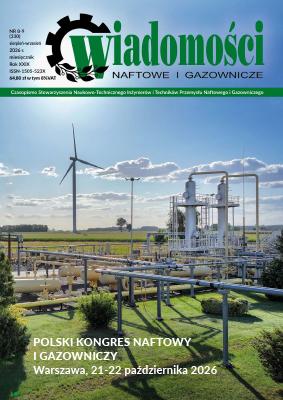
Latest issue of Oil and Gas News:
-
Underground storage of energy and fuels in a high-renewables energy system: a system necessity or a technological option? Porous space and rock formations as a strategic resource
The energy transition is usually described in terms of generation capacity, fuel shares and transmission networks. Far less attention is paid to the question of where the system will store energy and fuels during periods of low weather-dependent generation and high demand. The paper answers the question raised in its title: which underground storage functions are a system necessity, and which remain a technological option whose value depends on the pace and cost of alternatives. This paper treats the subsurface as the third layer of national infrastructure — alongside generation and networks — and examines five of its energy and fuel functions: natural gas storage, crude oil and liquid fuel storage, underground hydrogen storage, compressed air energy storage (CAES) and aquifer thermal energy storage (ATES). These functions are shown to compete for the same salt and porous formations, the same brine management capacity, the same drilling competences and the same administrative attention, while national policy manages them sector by sector, without a common map, a priority hierarchy or a schedule. For each function the paper identifies the appropriate security metric — deliverability rather than working gas volume alone for gas storage, the physical time required to release strategic reserves for fuel storage, power and discharge duration for CAES, and seasonal useful heat together with recovery efficiency for ATES — and the corresponding bottleneck. The analysis concludes that brine management is the binding constraint on the entire national cavern programme, and that the principal barrier is neither technology nor geology, but the ability to carry mature projects through the full sequence of administrative decisions. A seven-point government programme is proposed, covering a national subsurface balance, a hierarchy of functions, a national brine balance, system-service metrics, a consolidated legal framework, a portfolio of reference projects and the protection of oil and gas sector competences. Geological storage of carbon dioxide, governed by a distinct regulatory and economic logic, lies outside the scope of this paper... dalej -
Upstream sector in Poland: the remaining potential for oil and gas exploration in the mature petroleum provinces
The future economic prosperity of the oil industry in Poland is analysed in this contribution considering both local resource availability and global macroeconomic constraints. Market trends point to growing future demand for crude oil and natural gas, as well as a predominance of high price ranges for these commodities, which are favourable for the upstream sector. The key challenges facing this sector in Poland relate to the development of the local resource base. Petroleum provinces of Poland have been classified as mature, except the Baltic shelf. The exception is justified, among others, by the discovery in 2015 of the big oil field D33 (c. 210 million bbl oe). In the Pomeranian sector, new exploration targets may be identified in the deep, Devonian-Carboniferous tectonic grabens; however, these are currently documented only by 3D seismic data. Furthermore, the potential of the Western Pomeranian shelf is highlighted by the discovery in 2026 r. of the big oil field Wolin in the Main Dolomite. For the Wielkopolska sub-province, a significant increase in the resource base might be achieved by exploration for tight gas in the Rotliegend sandstone. In the Carpathians Foredeep, the hybrid, subconventional natural gas reservoirs in Miocene mudstone-siltstone heteroliths may play a similar role. Furthermore, in this basin, a significant increase in the gas reserves can be achieved by further development of large, multi-horizontal fields that are at an advanced stage of production. A characteristic feature of the Polish Outer Carpathians is that 50 % of the hydrocarbon reserves of the fields discovered to date are located in two folds in the Jasło–Krosno–Sanok region. The zone located along the migration pathways of hydrocarbons to these fields, situated directly to the south of these folds, is likely to contain yet undiscovered, deeply sited conventional oil and gas fields with considerable resources. Furthermore, in the Polish Outer Carpathians, accumulations of shale oil and microbial shale gas in the bituminous claystone and mudstone of the Menilite Formation, as well as tight oil and tight gas in the Cretaceous and Cenozoic sandstones, are recognised... dalej
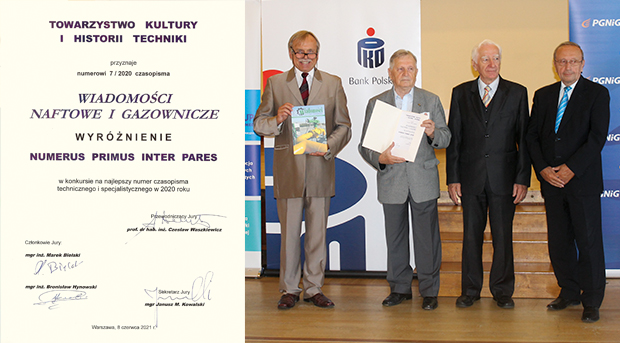
Od kilkudziesięciu lat, działające w ramach Federacji Stowarzyszeń Naukowo-Technicznych NOT Towarzystwo Kultury i Historii Techniki, jest organizatorem konkursu NUMERUS PRIMUS INTER PARES.
Z nieukrywaną satysfakcją (ale też z odrobiną miłego zaskoczenia) przyjęliśmy w Redakcji tegoroczny werdykt jury, obradującego pod kierunkiem prof. dr. hab. inż. Czesława Waszkiewicza – przyznającego numerowi 7/2020 Wiadomości Naftowych i Gazowniczych wyróżnienie NUMERUS PRIMUS INTER PARES na najlepszy numer czasopisma technicznego i specjalistycznego w 2020 roku.
Uroczyste wręczenie nagród i wyróżnień konkursu NUMERUS PRIMUS INTER PARES odbyło się 22 września 2021 roku na gali finałowej Ogólnopolskiego Konkursu Młodych Innowatorów 2020/2021 połączonej z Olimpiadą Wiedzy Technicznej. Uroczystość miała miejsce w przepięknym Warszawskim Domu Technika NOT – zabytkowym budynku o neobarokowej i neorokokowej architekturze. Z rąk jury konkursu wyróżnienie dla Wiadomości Naftowych i Gazowniczych i ich wydawcy SITPNiG odebrał kolega Maciek Bednarek (na zdjęciu drugi z lewej).
Redaktor Naczelny